
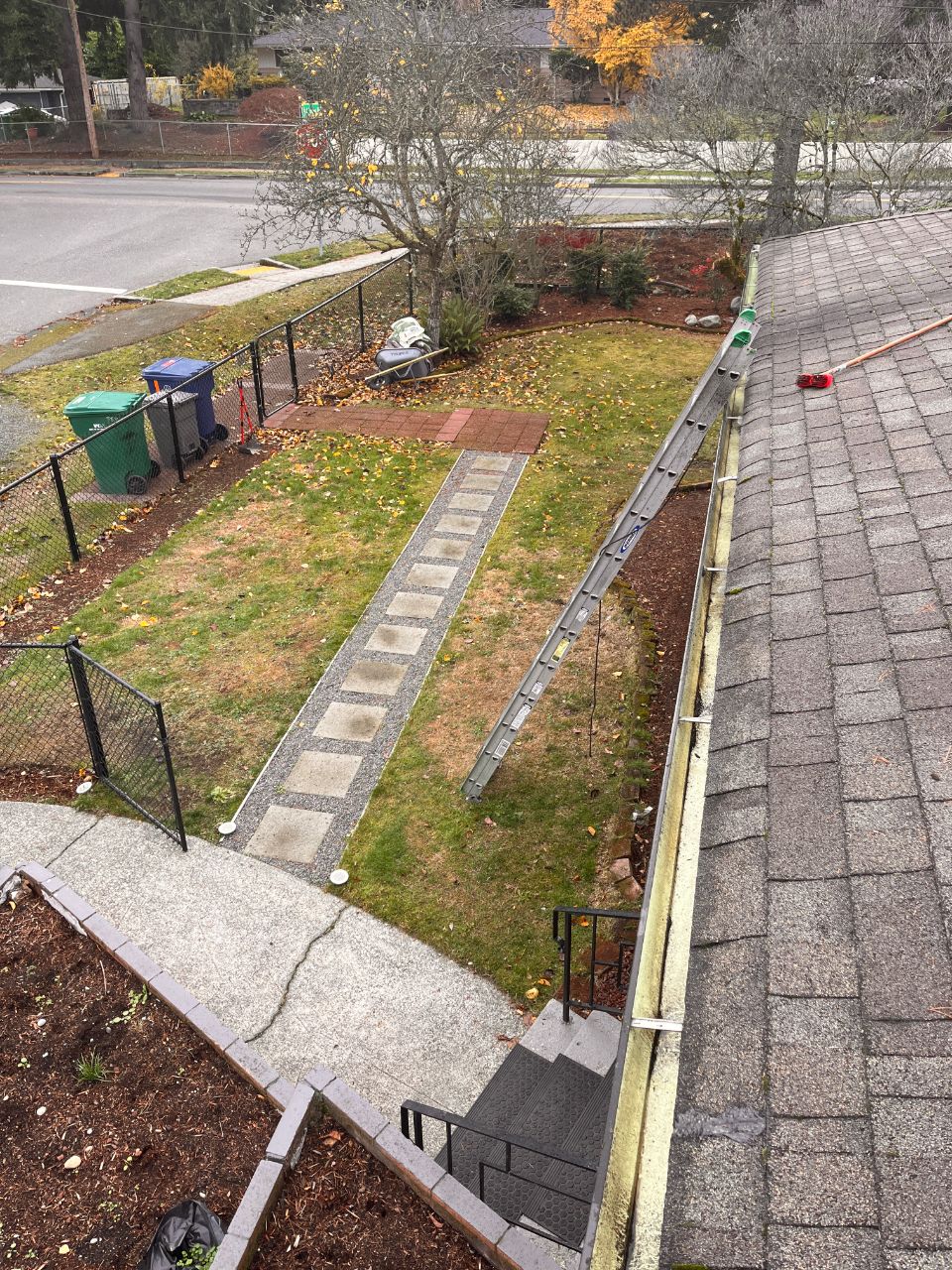
Western Washington homeowners ask us the same gutter questions every year: fir needles, moss powder, rain-season timing, and whether guards really mean never cleaning again. Here are the straight answers.
In Western Washington, the short answer to most gutter questions comes down to trees and rain. Conifers and big-leaf maples mean most homes under tree cover need a gutter cleaning two to four times a year, not once. Moss powder treatment is a roof service, not a gutter one, so a "gutter cleaning" visit and a moss treatment are two different line items. And yes, our crews clean gutters in the rain here. If we only worked on dry days, we'd work about four months a year.
That last point is the whole job description, honestly. Nobody becomes a Western Washington gutter cleaner because they love blue skies. We clean gutters because somebody has to, and the forecast says "mostly cloudy" roughly eleven months out of twelve.
Below are the questions we actually hear from homeowners in Everett, Lynnwood, Snohomish County, and the rest of our service area, answered straight, with real pricing from our own rate sheet, not a national average pretending to be local.
How often should gutters be cleaned in Western Washington?
Most homes here need gutters cleaned two to four times a year, more often under heavy conifer or maple cover. A single annual cleaning that works fine in a drier climate usually isn't enough once Douglas fir needles and big-leaf maple leaves are falling for most of the year.
Two visits a year (late fall and spring) covers a lot of lots with light to moderate tree cover. If your roofline sits under fir, cedar, or a mature maple, three to four visits is more realistic, because needles drop steadily rather than all at once the way deciduous leaves do. Homes near Puget Sound with heavier wind and rain also tend to see more debris blown in from neighboring trees, not just their own.
- Light tree cover, mostly open sky: twice a year, late fall and late spring
- Moderate cover, a few mature trees nearby: three times a year
- Heavy conifer or maple cover, shaded roofline: three to four times a year, sometimes more
Our Standard Cleaning runs $299 per visit, Cleaning + Roof Blow is $399, and Full Detail is $449, all per visit, which is how most of our recurring customers in this area end up scheduling two to four times a year instead of guessing.
Do Douglas fir needles clog gutter guards?
Yes, in many cases. Fir needles are narrow enough to slip through the openings in several common guard styles, and they interlock with each other and with grit from asphalt shingles, which builds a mat rather than washing through on its own. Independent reviews rate fine micro-mesh guards as the best performer against needles.
Reverse-curve and bottle-brush style guards tend to struggle most, since needles can work into the gap at the curve or slip between brush bristles. Foam inserts can block needles too, but foam degrades under UV exposure over time and is harder to clean when it does clog, and even micro-mesh still needs occasional maintenance. None of this means guards are a bad investment here, it just means "install guards" and "never think about gutters again" are two different promises, and only one of them is realistic.
Should moss powder be part of a gutter cleaning in the Pacific Northwest?
No, moss powder treatment is part of our roof cleaning service, not our gutter cleaning service. A gutter cleaning clears the trough and downspouts; moss growing on the shingles above it is a separate problem, and treating it requires an actual roof cleaning visit, not just a cleared gutter.
That said, the two are related. Moss and shingle grit on a roof wash down into the gutters every time it rains, which is part of why gutters here refill with fine debris between full cleanings even without a single leaf falling. If your roof has visible moss, especially on a shaded north-facing slope, scheduling a roof cleaning alongside your next gutter visit tends to cut down how fast the gutters re-clog, since you're removing the moss before it sheds into the trough. We offer Moss Removal + Powder starting at $450 and a Full Roof Restoration at $649, both per treatment, as a separate service from the gutter cleaning tiers above.
Is it safe to clean gutters in the rain or in winter?
Yes, with the right precautions, and we do it routinely since most of the year here is wet. The real hazard isn't rain itself, it's a wet ladder, slick moss on a roof edge, or actual ice. Our crews reschedule for genuine ice or high wind, not for ordinary Western Washington drizzle.
If you're doing it yourself, the risk math changes. A ladder that's fine dry gets noticeably more slippery wet, and wet gloves make it easy to lose your grip on a rung you'd normally trust. A wet aluminum rung under a rubber boot has taught more people about friction than their old high school physics class ever did. If there's any frost or ice on the roofline, that's the one condition worth waiting out rather than working around, whether you're on a ladder yourself or calling a crew.
Can wet debris damage my gutters or fascia?
Yes. Waterlogged needles and leaves are significantly heavier than dry debris, and that extra weight strains the hangers holding the gutter to the fascia board. Left long enough in a climate this wet, the fascia itself can start to soften and rot behind a gutter that's been overflowing or sitting full.
This is the quiet version of gutter damage, since it doesn't show up as a dramatic sag overnight. It shows up as a hanger that's pulled loose a quarter inch, then an inch, over a couple of wet seasons, usually noticed only once the gutter visibly pitches away from the roofline. Keeping the trough mostly empty through the wet months is less about the gutter itself and more about protecting the wood it's bolted to.
Why do my gutters still overflow after a cleaning?
Yes, a clean trough can still overflow if the real blockage is somewhere else entirely. A downspout further down the line, an underground drain tie-in, incorrect pitch, or sheer storm volume during a heavy Puget Sound downpour can all cause overflow even right after a thorough gutter cleaning.
The usual suspects, in more detail:
- Clogged downspouts: the trough looks clear but a downspout further down is packed
- Underground drain tie-in clogs: debris or roots blocking the pipe the downspout feeds into below grade
- Incorrect pitch: a gutter that doesn't slope properly toward the downspout pools water even when it's debris-free
- Storm volume: a genuine Puget Sound downpour can outrun even a perfectly clean system for a few minutes during the heaviest part of the storm
If overflow keeps happening right after a cleaning, it's worth getting a second look rather than assuming the cleaning didn't work. Request an estimate and we'll check the downspouts and pitch, not just the visible trough.
What is the best month to clean gutters in Snohomish County?
Late fall, after most of the leaf and needle drop has finished, is the single most useful cleaning of the year. A second visit in spring catches winter storm debris and whatever moss or grit washed down off the roof over the wet months.
Timing the fall visit too early means redoing it a few weeks later once the rest of the leaves come down; timing it too late means a full winter of rain pooling behind debris that's already there. If you're only scheduling one visit a year, which we'd generally advise against here, late fall is the one that matters most.
Do gutter guards mean I never have to clean gutters again?
No. Guards cut down how often a full cleaning is needed, but they don't eliminate it, since fine debris still gets through or piles up on top of most guard styles here. Fir and cedar needles, shingle grit, and moss spores are small enough to slip past or settle on guards that stop full leaves just fine.
- What guards generally stop: full leaves, larger branches, obvious whole-piece debris
- What still gets through or collects on top: fir and cedar needles, shingle grit, moss spores and fine silt, especially on guard styles with wider openings
- What guards don't change: downspouts and underground drain lines still need periodic checking, since those clog independently of what's happening at gutter level
If gutter guards actually delivered on "never again," we'd be out of a job, and we're still very much not. We still recommend a periodic check even on homes with guards installed, just spaced out further than an unguarded roofline would need. If you're weighing whether guards are worth it for your specific home, that's a reasonable thing to ask about when you request an estimate.
We serve gutter cleaning across Edmonds, Marysville, and the rest of our service area in Snohomish and North King County. If your gutters are overdue, or you're just not sure which tier makes sense for your roofline, get in touch and we'll walk you through it, no hard sell, no guessing at a number that isn't ours.